Transparency

Transparency Act Report 2025

Who are we?

Pharma Marine AS was established in 2007 and had 87 employees at the end of 2025. The group employed a total of 98 people.

Pharma Marine produces high-quality omega-3 products that are exported to large parts of the world. We are committed to continuing our traditions of responsibly managing the natural resources we harvest.

The company’s vision is:

“To develop sustainable, high-quality omega-3 products in an environmentally responsible manner, and to develop product formulations and delivery formats that enable as many people as possible to obtain their daily intake of essential omega-3 fatty acids.”

Pharma Marine sources raw oils both locally and globally, which are further processed at our production facilities on Terøy in Haram Municipality, Norway.

The company’s strategy is based on high quality, sustainability, and increased utilisation of by-products from fisheries to ensure that all raw materials are fully utilised.

Pharma Marine AS is an indirect subsidiary within a group where LKG Innovation AS is the ultimate parent company.
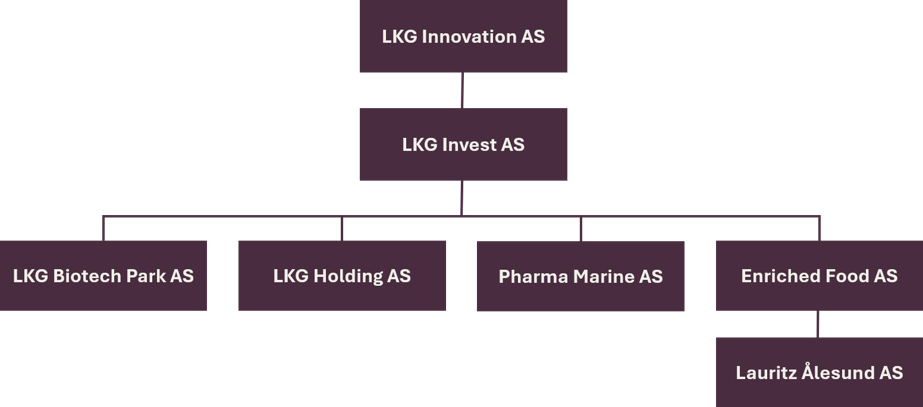
The group is organised with an intermediate holding company, LKG Invest AS, which manages the ownership structure. Other shareholders without controlling influence are not considered to have any significance for the company’s governance or due diligence assessments.

The group comprises several companies with different functions. LKG Biotech Park AS is a property company. LKG Holding AS primarily provides services within the group. Enriched Food AS and its subsidiary Lauritz Ålesund AS focus on the development of omega-3 product concepts.

In the company’s assessment, none of the other group companies are independently subject to reporting obligations under the Norwegian Transparency Act. Pharma Marine AS is the group’s operational entity, responsible for the development, production and sale of omega-3 products.

Our Markets and Products

Pharma Marine develops, manufactures and sells omega-3 products based on raw materials derived from fish, squid and algae to the business-to-business market. Products are supplied as bulk oils, bottled oils and portion-packed products. The company also sells by-products from its production processes, primarily for animal feed applications.

The company’s operations include both the sourcing of raw materials and their processing into finished products.

The company serves customers in Norway, Europe, Asia and North America. Procurement and deliveries take place locally, nationally and internationally. A more detailed description of the supply chain and relevant risk areas is provided later in this report.

Internal Governance

Responsibility for the company’s work related to the Transparency Act is shared across several departments:

  • The Board of Directors and the Managing Director hold overall responsibility for ensuring compliance with the Transparency Act and safeguarding fundamental human rights.
  • The HR department is responsible for internal compliance with company policies and procedures.
  • The Quality Assurance (QA) department, in cooperation with the Procurement department, is responsible for the assessment and approval of new suppliers.
  • The Procurement department is responsible for conducting supplier due diligence assessments.
  • The Finance department is responsible for handling requests related to the company's duty to provide information.

Human rights and decent working conditions are embedded in Pharma Marine through Norwegian legislation, collective agreements, the Employee Handbook and other internal policies. The company cooperates closely with employee representatives, the Working Environment Committee and occupational health service. The company actively promotes equal treatment, non-discrimination and equality throughout its operations. The Employee Handbook outlines employees’ rights and obligations and clarifies that human rights must be respected at all levels of the organisation. Employees are required to comply with applicable legislation, the Code of Conduct, the HSE Handbook and other internal procedures.

Pharma Marine is subject to regular audits by customers and relevant certification schemes. The company requires suppliers to respect fundamental human rights. Compliance is supported through established procedures, supplier questionnaires and requirements to sign the company’s Code of Conduct. Strict requirements apply to suppliers involved in food production, and specific guidelines have been established to ensure respect for human rights. Suppliers are also expected to communicate these requirements to their own suppliers.

Due Diligence Assessments

Pharma Marine AS conducts due diligence assessments in accordance with the OECD Guidelines for Multinational Enterprises on Responsible Business Conduct. Our work is based on a risk-based approach designed to identify, prevent and address adverse impacts on human rights and decent working conditions.

Mapping and Risk Assessment

Procurement from suppliers is based on a precautionary approach. Initial risk assessments are carried out based on factors including suppliers’ geographical location, with preference given to suppliers located inlower-risk areas whenever possible.

As part of the due diligence process, suppliers are assessed and prioritised based on:

  • Purchase volume and frequency
  • Supplier risk profile
  • Available information about the supplier

Suppliers are assigned a risk score based on internal assessments. These assessments draw on recognised external sources, including the ITUC Global Rights Index, CSR Risk Check, high-risk country lists and other relevant secondary sources used to evaluate country and regional risks. Suppliers are subsequently classified and prioritised according to risk, ensuring that monitoring and follow-up measures are directed towards areas with the highest potential risk.

Norwegian suppliers are generally considered to present a lower risk of human rights violations because they are subject to Norwegian legislation and, in many cases, the Transparency Act. Nevertheless, they are assessed in accordance with the company’s overall risk-based approach.

When evaluating international suppliers, particular emphasis is placed on:

  • Assigned risk score
  • Compliance with the Code of Conduct or equivalent standards
  • Available documentation, including ESG reports, policies and public statements

Based on these assessments, suppliers associated with higher risk are prioritised for closer monitoring.

Measures and Follow-Up of IdentifiedRisks

Pharma Marine requires suppliers to comply with fundamental human rights and decent working conditions. This is followed up through:

  • Requirements to sign the company’s Code of Conduct
  • Use of supplier questionnaires during onboarding
  • Dialogue and follow-up where risks are identified
  • Ongoing assessment and updating of supplier information

Where significant risks relating to human rights are identified, additional investigations and, where appropriate, follow-up or audit activities are carried out.

Monitoring and Continuous Improvement

The company continuously works to improve its due diligence processes. This includes:

  • Enhancing procedures and tools
  • Updating risk assessments
  • Monitoring suppliers over time

The due diligence process is continuously adapted based on experience, changes within the supply chain and available risk information.

Significant Risks and Impacts

Risks have been identified in relation to the sourcing of raw oils, including fish oil and squid oil, from certain geographical regions. Such purchases may in some cases be necessary due to limited availability of alternative suppliers. These risks are particularly associated with suppliers located in parts of Asia and Central and South America. In such cases, enhanced due diligence assessments and follow-up activities are carried out. It should be noted that suppliers operating in higher-risk regions do not necessarily violate human rights. Several of the company’s suppliers have established management systems, their own policies and procedures, and have either signed Pharma Marine’s Code of Conduct or implemented equivalent requirements.

To date, Pharma Marine has not identified conditions indicating actual severe adverse impacts on human rights or decent working conditions through its due diligence assessments. However, the company cannot rule out the possibility that such impacts may occur, and due diligence efforts continue to be developed and strengthened.

The company maintains an extensive international supply chain involving multiple categories of raw materials and production inputs. This creates an inherent risk of indirect impacts on human rights.

The due diligence assessments have also identifiedrisks related to transportation, including road transport within Europe, where working conditions and road safety issues may present potential risks. Transport services are primarily procured from established and reputable suppliers.

Measures to Reduce Risk and the Way Forward

Pharma Marine applies a precautionary approach in its due diligence efforts, with the aim of preventing adverse impacts before they occur.

The company has revised its Code of Conduct to strengthen requirements relating to human rights, anti-corruption, anti-money laundering and compliance with applicable regulations. These requirements have been implemented and communicated internally throughout the organisation.

Internal procedures to support safe transportation remain in place, including requirements relating to vehicles and safety equipment for winter conditions.

The company continues to use its revised supplier questionnaire to support the assessment of human rights and working conditions. The information collected provides a stronger basis for supplier due diligence assessments and ongoing improvements to the process.

Pharma Marine is also strengthening its procedures for obtaining and verifying supplier compliance information, including revisions to supplier declaration forms. Updated requirements are intended to ensure that suppliers communicate the company’s expectations throughout their own supply chains.

Due diligence is an ongoing process. The company’s objective is to ensure that both suppliers and sub-suppliers respect human rights and provide decent working conditions.

While substantial information has been collected as part of the due diligence process, the company continues to improve access to information and documentation from all levels of the supply chain.

Whistleblowing and Grievance Mechanisms

Procedures for internal whistleblowing are describedin the Employee Handbook and the HSE Handbook. The procedures apply to all employees and external personnel and are easily accessible. Notifications maybe submitted either openly or anonymously. All concerns are handled in accordance with established procedures.

External whistleblowing reports may be submitted to varsling@pharmamarine.no.

 Inquiries

All inquiries regarding this report and our work related to human rights and decent working conditions may be sent to aapenhet@pharmamarine.no and will be handled in accordance with the requirements of the Norwegian Transparency Act.

 Signed version (Norwegian)

Likestillingsredegjørelse 2025

Redegjørelse åpenhetsloven 2025

Tradition

for innovation